Thursday, October 21, 2010

Designing Puzzles Backwards (Part I)

In Part I of this article, writer-designer Steve Ince gives an overview of how story, plot, and gameplay feed into puzzle creation in a game.

I’ve spent most of my game development career working on various story-based games; mostly traditional adventures but other types, too. Although there are different kinds of puzzles involved in the creation of such a game, the kind I find most satisfying are the ones that tie the gameplay directly into the story by the means of shared objectives.

When I’m fortunate to have the opportunity to create both the story and design of a game, as I did with So Blonde, for instance, I like to work in a very iterative manner. I get the basic structure of the story sorted before working up some detail, which then allows me to start defining the gameplay objectives based upon that story, which then feeds back into the developing plot. By working this way, the plot becomes a high level structure that gives both the gameplay and story the shape it needs and enables me to start working up the puzzle details.

When I’m in a position to work on an objective related puzzle, I find it’s best to start with the objective and work backwards. By taking this approach I ensure that each step of the puzzle – or other gameplay that feeds into the puzzle – links to the objective in a clear way.

As I work on such puzzles I loosely go through a series of questions that help with the process.
  • What is the objective?
  • What is stopping the player character from reaching that objective?
  • How will the player deal with that blockage?
  • How will the player get the items/skills needed to do so?
  • Are there separate or side objectives the player has to deal with in order to get what’s required?
  • How can I make this more complex?
  • How can I make this more fun?
  • Is this series of events logical?
  • Is it clear to the player what they need to achieve and what they need to do to achieve it?
There may be plenty more questions relating to the specifics of a puzzle or the objects used and even the user interface, but the main thing to remember is that if you’re not asking yourself these kinds of questions, you’ve got to ask yourself why not.

Steve Ince is a Writer-Designer with 17 years in game development. After 11 years with Revolution Software, Steve turned freelance in 2004. In 2008 he received an award nomination from the Writers’ Guild of Great Britain for the game, So Blonde.

Friday, October 8, 2010

October 2010: Puzzles

October 2010's topic, Puzzles, was submitted by postdoctoral researcher Clara Fernández-Vara.

She writes:


Puzzles are one of the most common design challenges in games, and yet their design practices remain largely undiscussed. This is because puzzles come in many shapes and sizes. Professor Layton includes a wide range of traditional puzzles (logic puzzles, riddles, jigsaws, etc.). Metroid, Zelda and Ico are packed with environmental puzzles where the player must make sense of the space and manipulate its objects in order to traverse it; adventure games bring together story and gameplay by having each puzzle be an event in the story of the game. There is also a whole genre we refer to as puzzle games, such as Zuma, Tetris or Bust-a-Move / Puzzle Bobble.

This month, Game Design Aspect of the Month wants to encourage everyone to think about their practices to create puzzles in their games, and realize that puzzles are much more common than most designers will readily admit.
  • How do puzzles contribute to the gameplay of the game? If the game is puzzle-driven, how is it fun? If puzzles are just one type of challenge in the game, how do they relate to the rest of the activities in the game?
  • How can the story be supported by puzzle design? How do the puzzles relate to world design?
  • How does one get started devising a puzzle? How can designers evaluate if it is a good puzzle? What practices should be avoided?
Clara Fernández-Vara is a Postdoctoral Researcher at the Singapore-MIT GAMBIT Game Lab. Her work concentrates on adventure games, as well as the integration of stories in simulated environments.

Friday, October 1, 2010

Using Collectibles for Player-Controlled Difficulty

In this article, game designer Doug Hill discusses how game designers can use collectibles to allow players to adjust difficulty levels in games.

In his article Risk Vs. Reward: TACOs, Achievements, and YOU, Ryon Levitt discusses the relationship between the risk a player must consider in getting a collectible versus the reward of obtaining it. This article will consider the opposite side of this problem: taking a risk by not collecting something.

In the original NES classic The Legend of Zelda, you don't have to collect everything to beat the game. You don't even have to collect half of the items. If need proof, search for a speed run of The Legend of Zelda and you will soon see players beating the game from start to finish in around thirty minutes. These players manage to beat every boss and finish every dungeon while only getting a fraction of the game's plentiful power-ups.

So how these players accomplish something like this? Practice and planning. They learn the game forwards and backwards. They learn the enemy's attack scripting and spawn algorithms. They become so proficient that they no longer have to worry about getting all of the Heart Containers to increase their health. They don't have to worry about gathering enough money to buy the Blue Ring armor upgrade. They don't have to find the hidden letter to access the medicine shop. They have more than enough skill to beat the game without these items.

Most of us mere mortals, on the other hand, need a bit of a boost. The question is – how much of a boost? The nice thing about The Legend of Zelda and other games like it is the decision is left (mostly) in the hands of the player. It lets the player continue to collect all kinds of power-ups until they feel they have enough firepower to get through a dungeon. If the player fails, they can also go and collect more power-ups so they'll have a better chance when they try again. That is, unless the player has collected all of the power-ups already.

This school of game design is one of the primary reasons that many genres of games have garnered such a widely diverse fan base. Consider the role playing game, where players have the option of trying to collect extra treasure in order to become more powerful. In this case, the player is actually choosing which risk to take – go on to an area with stronger enemies or possibly a boss without getting stronger, or go after the treasure while having to fight additional foes? Even levels and experience can be considered collectibles that put the player in control of how strong they are before they attempt to move forward.

The point I'm trying to make is that, as game designers, we should not focus on making our games specifically easy or hard. Instead, we should try to leave as much of the difficulty level decision as possible in the hands of the players. If they want their game to be easy, we should let it be easy. Give the players cheat codes. Give them extra power ups. Litter useful items everywhere. Give them difficulty levels where they barely take damage and almost never run out of ammo. If your game is fun to play in and of itself, being easy shouldn't hurt it too much.

On the other hand, make sure you give a challenge to the players who want it. This can be through harder difficulty levels, achievements and trophies, or more difficult replays after they've defeated the easy mode. Most importantly, make sure they have choices during the game, not just before they start and after they finish. Give players weapons and power-ups they can skip and not use. Give them shortcuts they can choose to ignore. Give them easy and hard ways to kill bosses.

In the end, you'll get more players to appreciate your game. It won't feel too hard, while those seeking a challenge will find one without having to look too hard.

Doug Hill is a freelance game designer and writer who has worked on a variety of published video games over the past ten years. His current focus is developing intellectual property for use in both interactive and non-interactive media.

Wednesday, September 29, 2010

First, Do No Harm

In this article, gameplay programmer Nels Anderson warns that more does not equal better when it comes to collectables, especially when their very presence may contradict the gameplay experience.

Designed correctly, collectables can enrich a world, making it feel larger and more robust. Designed poorly, they exploit some of our worst tendencies as gamers. Usually games feature one or the other, and it's unusual and interesting when both exist (at times, literally) side-by-side.

Lately, I've been playing longer single-player DLC from some of the bigger releases earlier this year. Along with Minerva's Den for Bioshock 2, I've been playing The Signal for Alan Wake (it came free with the game). It reminded me of the stark contrast Alan Wake presents in its collectables. I wrote about Alan Wake previously, but I wanted to go into more detail about the collectables themselves.

To be clear, Alan Wake has far too many collectables. There are: manuscript pages, coffee thermoses, supply crates, can pyramids, radio clips, TV shows and local history signs. The Signal adds two more, ticking clocks and cardboard standees. And, of course, there's an individual achievement for collecting every one of these. It's absurd. I can only imagine it emerged from group-think that concluded, "People like collectables, and some collectables are good, so more must be better!" And Alan Wake isn't even a sprawling open world with vast environments the player is never required to visit but can explore at their leisure. It's a linear, level-based game whose environments are, if anything, too big.

I'm not trying to pick on Remedy or Alan Wake, because they did some very good things with their collectables. It's just that the good things are sitting right next to some things that are ... less good. And the good collectables are quite good. The two most successful were the radio segments and Twilight Zone-esque TV shorts. They follow the guidelines for good collectables: 1) they're rewarding in their own right, 2) they enhance the game thematically and 3) they're sensibly located. They're rewarding because they are (at least potentially) amusing or provide some backstory. They enhance the game thematically because late night radio feels both lonely and creepy (Mitch called that one) and the TV spots are appropriately absurd. And they're sensibly located because they're both found in man-made structures (that are not ruined/abandoned).

At the complete opposite end of the spectrum are the game's one hundred coffee thermoses. They have no purpose in the game beyond provide an achievement, and beyond a tenuous Twin Peaks joke they're not thematically appropriate and they're scattered from hell to breakfast. You're as likely to find one in someone's kitchen as you are to find one perched on top of a boulder deep in the woods. The can pyramids are just as bad, while the manuscript pages and supply caches fall somewhere in the middle.

But why are "bad" collectables bad? If some people don't like them, they can just ignore them, right? The problem is poorly designed collectables can have subtle but dramatic impact on the game's pacing (again, see Mitch's piece). In Alan Wake, you're often chased or running toward something important. You're supposed to feel rushed and threatened. But as this is a pretty standard game and the world's state cannot actually change until the player is nearby, that's entirely smoke and mirrors. Now that would be okay (a lot of great games are mostly smoke and mirrors) except the presence of the poor collectables encourages the player to take the game very slowly and methodically, scouring an environment entirely before moving onward. Once again, it's that old chestnut where the game's fiction says one thing ("Run! Hurry!") and the game's rules say another ("Slow down and find all those thermoses").

There's no doubt in my mind Alan Wake would be a better, more cohesive game without those thermoses. The danger really is thinking that arbitrary, pointless collectables are good because people like them. It's true that they're effective for many people, but they might be effective for all the wrong reasons. And effective isn't the same thing as good. Alan Wake shows us how seamlessly good collectables can integrate into a game. And in the next breath, it shows how harmful poor ones can be. More isn't always better. Let's not forget that, okay?

Nels Anderson is a gameplay programmer at Hothead Games. He's probably the only game developer in Vancouver (and maybe all of Canada) that was born and raised in Wyoming. He writes about games and game design at http://www.above49.ca. A version of this post originally appeared there.

Sunday, September 26, 2010

Risk Vs. Reward: TACOs, Achievements, and YOU

In this article, game designer Ryon Levitt discusses how to make collecting totally arbitrary collectible objects (or TACOs) a meaningful and fulfilling activity for players.

Since as long as I can remember, I’ve been somewhat of a completist when it comes to video games. I will admit that as I’ve grown older, my definition of “complete” has changed due to the amount of time I have for any particular game, but I still feel like I should try to get as much out of any game I play. For this reason, I find that the concept of collectibles to strike a very close chord with me.

I have collected many things in my life, Sonic’s Rings and Mario’s Coins, items that let me survive longer, making game completion more achievable; Sonic’s Emeralds which changed endings; the many arbitrary icons and photo points in Grand Theft Auto: San Andreas that gave me access to tools in-game; Battle Trophies in Star Ocean: Till the End of Time that gave me costumes and difficulty levels; Legendary weapons in countless RPGs; Bestiary entries; and more modernly, PS3 Trophies and Xbox Achievements.

And what have I learned from years of collecting items with little-to-no real world value? Collecting things makes you feel good… as long as:
       
            A) you feel you earned them.
            B) you feel that what you got was worth the effort put into it.

So what does this mean from a design standpoint?

As designers, it’s our job to make whatever collectibles we put into a game as lucrative to get as possible. A collectible with no meaning is a waste of time to collect and will only be a source of frustration to our players. At the same time, if we make them lucrative to collect, the challenge to get them should reflect that. A large reward without any risk is just a gift, which may be nice, but really is equally meaningless.

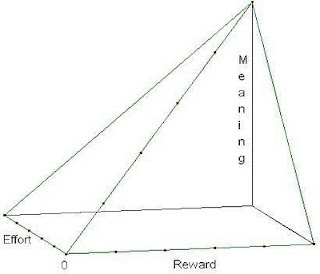
Effort vs. Reward vs. Meaning
It’s easy to see examples of games that can fit all over the above chart. MMOs and RPGs and any other game that relies on percentage chances for rewards often force players to put in a lot of effort for variable value rewards. “Get me 5 rat tails for this Health Potion”. In itself, it’s a low-effort task – rats are easy to kill. But when a rat doesn’t always drop a tail, suddenly the task has become tedious as you have to kill 50 rats for the 1/10 drop. Some developers may feel that this increases gameplay time, but I’m of the school of thought that if something needs to be earned, then it is better to make the challenge harder, not longer. As such, Tedium can be considered to reduce the value of a reward. If a reward is high effort and high reward, but extremely tedious, then it should be treated as though the reward is actually lowered.

On the other side of the graph, we look at achievements that are “earned” without having to do anything. Without naming any titles, there has been numerous mentions of games that give the entire set of Achievements by just completing each stage – and the stages aren’t particularly difficult either. Sure, people who care all about their score will pick up these titles to abuse the system, but really what do those points mean if they are getting them without actually achieving anything? Isn’t the act of achieving something the meaning of Achievements?

Finally, there is the top of the graph, the area at the top of the Meaning axis. This area is the hardest to give examples for because Meaning means different things to different people. In its purest sense it is the sense of accomplishment – getting the high score, getting the 100% completion, getting the uber weapon - whatever it may be, it is different for each game and for each player. Not every game has a collectible in this area, though the games that are considered the most satisfying by fans and critics alike always do. Having an abundance of high-meaning collectibles for a game can prolong its life – even the classics from the 8-bit and 16-bit eras have fans constantly coming back for those 100% completion runs because they feel good to achieve.

So in conclusion, collectibles are definitely an important part of the design process and one that should take a lot of thought by the design team. Collectibles need to have meaning for them to be worth getting and to give them meaning, the effort to get the collectible and the reward from getting the collectable have to be balanced. If games have meaningful collectibles, then they will enjoy longevity by people who have earned the sense of satisfaction.

Ryon Levitt is a programmer-turned-designer for TECMO KOEI CANADA, with about 3 years of credited design experience.  Ryon is one of the founding members of the IGDA Game Design SIG, and helped coin the acronym GDAM.

Thursday, September 23, 2010

October 2010 Poll

Please vote for the October 2010 topic!  As always, feel free to suggest more topics!

Also, podcasts may return in the near future!

You'll see the poll to the right. The choices are:

  • Puzzles
  • Sequels
  • No More War Games?
No More War Games?
Videogames have a heritage in that they were constructed from display technologies developed because of the Cold War. The first games all resembled some form of war simulation (with Pong being an exception), what would it take to skirt this trend and start developing games that do not revolve around war?

Tuesday, September 7, 2010

September 2010: Collection and Completion

September 2010's topic, Collection and Completion, was submitted by game designer Doug Hill.

Doug writes:

From munching dots in Pac-Man to unlocking achievements and trophies in the hottest new AAA game for Xbox 360 and PlayStation 3, the act of collecting and completing has been a central part of video games for over three decades now.

The collection and completion design is clearly one of the most tried and true mechanics for adding longevity to the video game experience – but is it flavor or filler? Do collecting and completing enhance our design, or are we distracting players from the real heart of our games' designs?

In this month's topic, Game Design Aspect of the Month wants to explore the means and the method behind this core mechanic in so many games. Here are some potential topics to explore:
  • How can we implement 'collection and completion' mechanics that enhance the quality of our games rather than distract from it? Is it possible?
  • How does the 'collection and completion' mechanic affect player psychology? Is driving our players to complete every collection healthy or detrimental?
  • What are some of the key characteristics that make 'collection and completion'-centric games (such as Pokemon) so successful? Does it lie with the mechanic and how it is implemented, or is it found elsewhere?
Doug Hill is a freelance game designer and writer who has worked on a variety of published video games over the past ten years. His current focus is developing intellectual property for use in both interactive and non-interactive media.