Showing posts with label Diversity. Show all posts

Monday, March 21, 2022

Save the Date: Webinars Coming

I just joined Instagram for the first time this week and discovered the drawing that accompanied my quarantine essay, "Dear Daughter," was posted there. The autobiographical essay was the first memoir type of writing that I had ever published and it was later included in Covid-19 memory projects and in ArtsWestchester's exhibition, "Together apART: Creating During Covid."  During the pandemic, I discovered what it was like to be considered an artist.

I had also reconnected with Cori Myers (or Gameinatrix) from Gamer Girls Radio (GGR), the longest running all-female gaming podcast in existence.   

I learned after-the-fact that I had been included in GGR's March 2021 spotlight of Amazing Asian Women in Tech, Gaming, and Streaming. Thank you!

At the same time, I've been interviewing hiring managers and updating my webinar on game writing portfolios. What I've learned is that hirers are eager to discover that next great writer and find that diamond in the rough. In my webinar, I'll tell you how to make sure they notice you.


Save the Date!  Saturday, April 30 will be the next webinar date.

If you're applying to game writing jobs, you want your writing portfolio to stand out. Let your game writing portfolio rise to the top!

In May, I'll debut a brand new webinar dedicated to demystifying the writing test. 

Sande Chen is a writer and game designer with over 20 years of experience in the industry. Her writing credits include Independent Games Festival winner Terminus and the PC RPG of the Year, The Witcher, for which she was nominated for a Writers Guild Award in Videogame Writing. She is the co-author of Serious Games: Games That Educate, Train, and Inform, a founding member of the IGDA Game Design SIG, and an expert in the field of educational game design.

Sunday, January 16, 2022

Watch my interview on Negocios TV

What a thrill to do this interview with Bisila Bokoko on Negocios TV, a business channel. Bisila Bokoko herself is a truly awe-inspiring woman and she has helped female entrepreneurs achieve their dreams. We chatted about different topics regarding the video game industry including how to help women break into the game industry and the importance of female game players. 

Thursday, June 11, 2020

Systemic Racism in Idealized Fiction

In this article, game writer Sande Chen explains how idealized fiction can send an unintended message by ignoring racial injustices.

Earlier this year, I was able to attend a remarkable WGA, East Webinar about the report, "Normalizing Injustice: The Dangerous Misrepresentations That Define Television's Scripted Crime Genre," which explains how racial injustice is still reinforced even though diversity may be represented in these television crime shows.

As was pointed out in the Webinar, it's like racism has been erased in these shows. On the show, it's commonplace for a 65 year-old black woman to be a judge or hold a high-ranking position, but what's concerning is that none of the institutionalized racial injustice is ever addressed. These minority characters are inherent supporters of the system.

I found this line of thought eye-opening and intriguing. Others wondered if viewers or players would want to think about issues of inequality and discrimination while consuming their favorite media.

However, we know that the influence of media is important and as writers, we can and are often asked to depict a more enlightened society. The impetus to show diverse characters in our stories is not only to make things interesting, but also, to break stereotypes. We've seen it in TV remakes like Roswell, where the formerly all-white character list has disappeared. I think the writers did a good job of incorporating the new ethnic and sexual identities and blending them with topically relevant issues like immigration. They didn't do a cut and paste, like I described in the blog post, "Interchangeable He and She," where the hypothetical solution was to simply change pronouns.

My feeling is that replacing a male, white judge character with a 65 year-old black woman can feel like cut and paste. We should want more. We should be curious about her background. What were her struggles to get to where she is now? It's not about harping about social change, but just accepting that this character might have had a harder time than just applying and going to law school.

Sande Chen is a writer and game designer whose work has spanned 10 years in the industry. Her credits include 1999 IGF winner Terminus, 2007 PC RPG of the Year The Witcher, and Wizard 101. She is one of the founding members of the IGDA Game Design SIG.

Thursday, January 18, 2018

IGDA Survey Shows Diversity and Job Stability Concerns

In this article, game designer Sande Chen relates the lack of progress on diversity and job stability, as indicated by the IGDA 2017 Developer Satisfaction Survey.

The IGDA's 2017 Developer Satisfaction Survey (DSS) was released last week (and can be downloaded here) and in it, you'll find that according to the data, the typical worker in the video game industry, whether freelance, self-employed, or employed, is a 30-something, white or multiracial with white, heterosexual, college-educated, married male without a disability or children.  According to the 2017 survey, 74% of respondents identified as male while 21% identified as female.  Despite growing interest in the importance of diversity, very little has translated into actual change at companies, as can be seen from the similar results on the 2014 DSS survey.  


The survey also provided a snapshot of an industry with constant job volatility.  Even though 70% of respondents were permanent employees, on average they had already switched employers twice within 5 years. This is consistent with surveys from prior years. And only 39% expected that they would stay with their current employer for 3 years or less. 53% reported that crunch time was expected at the company and employees would work anywhere from 50 hours to more than 70 hours a week during crunch.

Just like the permanent employees, freelancers or contractors who responded to the survey predominately had 6 years or less experience working in the industry. But unlike the permanent employees, freelancers tended to have a longer relationship with clients, which leads to the concern that freelancers may be de facto employees, just without benefits or regulatory rules. The IGDA believes there is a real danger of freelancers bearing the brunt of the development work without any protection from potential abuse.

Sande Chen is a writer and game designer whose work has spanned 10 years in the industry. Her credits include 1999 IGF winner Terminus, 2007 PC RPG of the Year The Witcher, and Wizard 101. She is one of the founding members of the IGDA Game Design SIG.


Friday, January 5, 2018

The Passion Requirement

In this article, game designer Sande Chen weighs the pros and cons to hiring super-passionate game fans.

In a recent New York Times article about Nintendo, an interesting Shigeru Miyamoto hiring tidbit came to light.  He said, “I always look for designers who aren’t super-passionate game fans. I make it a point to ensure they’re not just a gamer, but that they have a lot of different interests and skill sets.” The article states that many of the current staff hadn't been gamers when first hired.

Considering that as a designer, Shigeru Miyamoto is inspired by everyday life (Pikmin was inspired by his gardens), this statement from him is not altogether surprising, and many people would agree that aspiring game designers should have broad interests and seek a liberal education.  However, a lot of game job adverts do call for "passion" for games. It's almost like a requirement.

And what is passion? Is it just regular enthusiasm?  Is it code for "hardcore gamer" or perhaps "superfan," at least for the company's products?  A recent Verge article points out sometimes, "passion" can be PRSpeak for "rude, obnoxious, and toxic."  And with the recent World Health Organization draft on gaming disorder, is "passion" just a nice way of saying "mental health addiction"?

One advantage to having gaming fanatics as new employees is that they are already up to date with gaming culture.  They understand what gamers want and how gamers act.  They already know the history of gaming and what's the latest craze.  They may play the latest games and know all the latest game news.  Moreover, they may know your game inside and out.  They fit in.

This requirement, however, could exclude a lot of worthy candidates.  In the past, women hires didn't have that gaming acumen but had expertise from related fields like entertainment or the technology sector.  By not hiring diverse employees, companies may stagnate, appealing to the same limited market instead of broadening its appeal.  As I have mentioned before at conferences, there are case studies where diversity of employees have led to expanded markets and more profit.  A diverse pool brings new perspectives, opening the door to originality.  In an industry where copycat games can run rampant, it can pay off to be the first mover.

What do you think? Is passion a requirement for you?

Sande Chen is a writer and game designer whose work has spanned 10 years in the industry. Her credits include 1999 IGF winner Terminus, 2007 PC RPG of the Year The Witcher, and Wizard 101. She is one of the founding members of the IGDA Game Design SIG.

Thursday, August 17, 2017

A Double Standard for Female Characters?

In this article, game writer Sande Chen implores others to think about how female characters are portrayed and developed.

Women in fields like high tech can feel like they're pushing against a double standard. They have to prove that they're beyond qualified for the job while at the same time, receiving a lower pay. They may feel like they're treated differently or belittled, their ideas claimed by male colleagues who fail to even let them finish speaking. I sometimes feel that female characters must feel the same way.  Think about how you treat your female characters.  Are they given the same opportunities as male characters?

For a long time, in film, the prevailing thought was that movies with female protagonists would never be major successes so why bother?  (Though recently, Wonder Woman smashed box office records.)  This same mantra seems to be repeated in the video game industry.  According to the 2013 Electronic Entertainment Design and Research Report, only 3% of top console games from 2005 to 2013 had female protagonists and publishers had very low expectations, as reflected in the low marketing budgets of those games. One game developer with a female-fronted game commented on how hard it was to get publishers to change their views: "We had some [companies] that said, 'Well, we don't want to publish it because that's not going to succeed. You can't have a female character in games. It has to be a male character, simple as that."

TERA
This had led to the male character being the default playable character, especially in mobile games, with female playable characters falling into the optional "pay extra" category or simply non-existent.  Despite it all, female players still clamor to be heard. They want female playable characters.  Repeat, this is just about the mere inclusion of a female playable character!  Even when female playable characters are included, they may be hypersexualized just like non-playing female characters whose only value seems to be their physical attributes.

If your game doesn't have a female protagonist, maybe you have a female character in a supporting role?  Let's hope she's not a badass there just to support the male hero as a plot device, much like the character Trinity in The Matrix. Give her a fully realized story of her own that could function as a subplot.

Does your female character have strong opinions? Careful now. Here's where criticism may come. Maybe she's too brash. Or too unlikable. Comes off as "too male."  These are charges that probably wouldn't ever be leveled against male characters.  Male characters tend to get away with all sorts of off-putting personality tics.

Male characters also don't tend to be threatened by sexual assault.  Yes, sexual assault is a concern for women and pertinent to some stories, but don't use it for shock value or as a plot device for the male hero to seek revenge.  Sexual assault shouldn't be the "go-to standard" for a female character's traumatic childhood. Don't use rape or attempted rape as a way to make a story "edgy." I'm sure there are other ways to insert danger into a female character's life story.

Female characters are deserving of better treatment. They too can have deep, intriguing back stories. We don't have to turn them into seductresses or subject them to sexual abuse.  We can attribute more value to them than their physical appearances.  Let's make sure we aren't applying a double standard and create stories that celebrate female characters.

In an idealized society, I wonder what female characters will be like, and if you would like to join me, I will be holding another writing workshop in New York City, Writing for Sci-Fi, Fantasy, & Horror Game Worlds, next Wednesday, August 23rd, at Microsoft NY.

the details!
Date:  Wednesday, August 23rd, 2017
Time: 6:30 to 9:30 PM
Place: Microsoft NY, Times Square
Tickets sold by PlayCrafting NYC

A writer and game designer, Sande Chen has over 10 years experience in the industry. She studied science fiction and science writing at MIT. Her first published game was the epic space combat RPG, Terminus, which won 2 awards at the 1999 Independent Games Festival. She was later nominated for a 2007 Writers Guild of America award in Videogame Writing for the dark fantasy RPG, The Witcher.


 

Thursday, July 6, 2017

Diverse Character Design and Representation GDoC Expo

In this video from Game Devs of Color Expo, panelists Amaryah Shaye Armstrong, Sande Chen, Yussef Cole, Tanya DePass, and Dina Abou Karam provide an in-depth look into the issue of diverse character design and representation.

Did you miss the Game Devs of Color panel, Diverse Character Design and Representation in Games?

We had a lively conversation about the portrayal of minorities in games, the lack of minority characters especially in fantasy settings, and how assuming the default character is white affects game development processes.  As a call to action, the panelists urged audience members to support minority game projects through Kickstarter or Patreon, to consider hiring a diversity consultant, and to look more closely at company hiring practices.

Diverse Character Design and Representation in Games 
Game Devs of Color Expo
, June 24, 2017

Five games industry professionals will further the case for diversity in character design during this panel. Topics to be discussed will include the portrayal of dark skin in games, representation of Arabs in video games, queer people of color in games, whitewashing, and cultural appropriation.

PANELISTS:
Amaryah Shaye Armstrong 
Sande Chen [Writer and Designer]
Yussef Cole [Writer and Visual Artist]
Tanya DePass [Director, I Need Diverse Games]
Dina Abou Karam [Artist/Game Designer]

Check out the video below:


Friday, December 16, 2016

The Choice For Female Characters Part II

In this article, game writer Sande Chen looks at new data from a study on gender representation in media and again calls on content creators in the game industry to make a choice to include more female characters in their games.

It's been a while since I wrote this post about gender diversity in games. I remember a certain pushback from members of the game development community who felt somehow that a call for gender diversity, or any kind of diversity, was impinging on their personal expression.  They felt like they shouldn't have to sacrifice their creative vision for the sake of diverse representation.

However, I didn't quite see how deciding that a bit-part NPC Doctor #2 would be a female doctor or composing a crowd scene to have more female faces would make much difference to their original vision.  It's simply about reflecting the real world and in the real world, there are female doctors and there are females in crowds.  Yet, in the strange skewed zone of pretend worlds, as the Geena Davis Institute on Gender in Media has shown, females are underrepresented.  This may not seem like a big deal, but it makes an impact on the psyches of young girls, who subconsciously get the message that females are invisible.

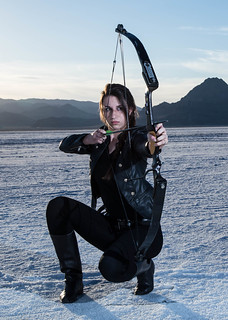
On the flip side, when there are empowering female heroines in media, young girls respond with emulation.  Because of the popularity of The Hunger Games series, Brave, and Game of Thrones, the sport of archery has seen a boost among teenage girls. Archery memberships purchased by women shot up by 105% in 2014.  As the Geena Davis Institute says, "If she can see it, she can be it."


Photo by Hayden Beaumont
At the 4th Global Symposium on Gender in Media on September 22, 2016, held at Google in New York City, a new software tool developed by researchers at USC Viterbi School of Engineering using Google's machine learning technology was unveiled.  This automated system, known as the Geena Davis Inclusion Quotient (GD-IQ), tracks speaking times and screen time using face-tracking algorithms and audio analysis.  It allowed researchers to quickly and efficiently analyze the top grossing (non-animated) films of 2014 and 2015.

Their research showed that in 2015, male characters generally spoke twice as much as female characters and received twice as much screen time.  Specifically, in box office hits with male leads, male characters spoke and appeared three times more often, and even in films with female leads, male characters spoke and received as much screen time as female characters.  In films with both female and male leads, male characters still received significantly more screen time.

But was this because male characters bring in more box office revenue?  Not exactly.  On average, 2015 films with female leads earned 15.8% more than films with male leads.  Films with both female and male leads earned 23.5%
more than films with male or female leads alone.

I'd like to emphasize that no one thinks that creators are purposefully creating male-dominated crowd scenes or actively trying to exclude female characters.  Rather, it's a subconscious societal bias that we as a community can start to notice and rectify.

Sande Chen is a writer and game designer whose work has spanned 10 years in the industry. Her credits include 1999 IGF winner Terminus, 2007 PC RPG of the Year The Witcher, and Wizard 101. She is one of the founding members of the IGDA Game Design SIG.

Saturday, June 4, 2016

A Doll Like Me: Disabilities in Games

In this article, game designer Sande Chen explores the nature of disability in video games.

After seeing this emotional video of a young girl receiving an American Girl doll with a prosthetic leg, I can see that character representations in games and toys do matter.  "A doll like me," the girl says, overcome with tears of joy.  It's only natural that a girl with a prosthetic leg would want a doll with a prosthetic leg.  Those with disabilities want their favorite toys to reflect their own lives.


Though this particular doll was modified pro bono by a different company, American Girl is no stranger to petitions to include the disabled.  In 2012, American Girl released a line of accessories such as wheelchairs, seeing eye dogs, walking canes, and crutches.

When I've had occasion to play with children online in games with character creation tools, I've found that they like to make characters that look like them.  They adjust skin tone as much as eye and hair color.  They want female characters to be in the game world as much as male characters.  I have never seen disabled characters as an option.  Granted, it might not fit in with the narrative fiction, but most games have fantasy elements (I'm counting even power fantasies), so why not an avatar in a wheelchair?

I know that there have been games made especially for the blind or for those with learning disabilities.  There have been games that try to make us feel like a schizophrenic or a depressed person.  A lot of developers are recognizing the need for accessibility options, whether it's a different color scheme for the colorblind or a way to customize keys.  These options concern disabled players, but what about disabled characters in games?

Among disabled game characters, there's been amputees who gained a high tech appendage or characters who viewed their disabilities as something to overcome.  I think I would prefer it if the stories didn't focus too much on their disabilities.  Perhaps the disability is even an advantage, much like in the movies Notting Hill and Four Weddings and a Funeral.  Those characters do have a back story about their disabilities, but they don't dwell on it.  Although their disabilities are obvious, they have accepted the way they are and the way life is for them.

Sande Chen is a writer and game designer whose work has spanned 10 years in the industry. Her credits include 1999 IGF winner Terminus, 2007 PC RPG of the Year The Witcher, and Wizard 101. She is one of the founding members of the IGDA Game Design SIG.

Tuesday, March 22, 2016

Podcast: The Value of Games in Education

A few weeks back, I did an interview with the Learning Partnership, a charitable organization dedicated to supporting, promoting, and advancing publicly funded education in Canada through lasting partnerships between business, government, education, and community organizations.

Listen on to hear about gamification vs. game-based learning, chocolate-covered broccoli, careers in the game industry, and more.


Sande Chen is a writer and game designer whose work has spanned 10 years in the industry. Her credits include 1999 IGF winner Terminus, 2007 PC RPG of the Year The Witcher, and Wizard 101. She is one of the founding members of the IGDA Game Design SIG.

Monday, September 7, 2015

Upcoming Panels on Diversity, Storytelling, and Game Writing!


Hi, in addition to the Game Writing Portfolio Workout on September 28 (Update!  New overflow class date October 20 added), I'll be speaking on a couple panels this month as well as at New York ComicCon (Yay!) in early October.

I'm excited to represent Women in Games International (WIGI) on a panel about diversity initiatives in law and technology.  I've spoken about the need for diversity in the game industry at GDC, Austin Game Conference, and most recently, at the 2015 Different Games Conference.  I was recently profiled in "6 Inspiring Women Who Have Succeeded in Male-Dominated Industries" and I'm really interested in hearing what other industries have done to help women succeed.

The panel is open to the public.  To attend, RSVP to innovation@nyls.edu by Sept 14.

Tech Talk: Diversity in Law & Technology
Wednesday, September 16, 2015
5:30 - 7:00 PM  (Networking at 5:30, Panel at 6:00)
New York Law School, Room W300


The following week, coinciding with IFP Independent Film Week, I will be on a NY Film Loft panel about women influencers from film, TV, digital media and gaming. A limited amount of tickets for this event will be available. Otherwise, it's invite-only and event attendees will be from top media companies, press and content creators.

Register here to learn about storytelling in various entertainment forms. General admission includes event, beverages/snacks and digital download.

Storytime: Women in Media & Entertainment
Tuesday, September 22, 2015 
6:30 - 9:00 PM (Networking included)
COWORK|RS
115 E 23rd St, 3rd Floor, NY, NY 

Update: Due to unforeseen logistical issues, this event has been postponed until October.


Sande Chen is a writer and game designer whose work has spanned 10 years in the industry. Her credits include 1999 IGF winner Terminus, 2007 PC RPG of the Year The Witcher, and Wizard 101. She is one of the founding members of the IGDA Game Design SIG.

Saturday, August 15, 2015

I'm Offended. Is It You, Me, or the Character?

In this article, game designer Sande Chen distinguishes between offensive characters and offensive material, and explains why it's important to keep track of authorial tone.

"I'm offended because it's so misogynistic," said one of my classmates in a playwriting workshop years ago.  I was stunned, not only because she had dared to make an objection against the work of the Theatre Department's current media darling, but that she had given voice to the uneasy feelings I had about the play presented before me.  The young white male protagonist in the play made bawdy jokes about women, the kind that would usually be followed up in real life with, "Awwwww, c'mon, can't you take a joke?" This led the professor to question, "Do you think it's the character that's misogynistic or the play that's misogynistic?"  At some point, I came to the private conclusion that the play itself was misogynistic because of authorial tone, which would suggest somewhat that the author himself was misogynistic.
Image courtesy of fotographic1980 at FreeDigitalPhotos.net

If a character in a fictional work is misogynistic, then it's seen as a character trait that isn't reflective of the author.  The character trait could be balanced or justified.  It depends on the situations presented in the fictional work.  There might even be other characters that offer a liberal viewpoint, as in the 1970's popular sitcom, All in the Family.   The viewpoints of the "lovable bigot," Archie Bunker, are constantly challenged and therefore, the show and its authorial tone becomes more about promoting tolerance in society.

Even when a fictional work can be considered to be misogynistic or racist and so forth because of the authorial tone presented, or in the case of games, because of art or game mechanics that can be interpreted in societal light, it's hard to say that there is one person at fault when it's a group activity.  An unproduced script has only the author, but a play on the stage is subject to the interpretations of the director and the cast.  The blame often goes to the person who is seen to have the most creative control.  Filmmaker D.W. Griffith is considered a racist for A Birth of a Nation, but it turns out that he might not have cared about racial politics.

In game development, there are so many moving parts.  Who exactly is in control of authorial tone?  Is it the narrative designer, the creative director, or the artist who decided to add something extra?  Whether it's due to lack of research, lack of sensitivity, or a lack of understanding how the content will be perceived, there will be players who find offense.  The offense doesn't even have to be about gender politics.  Maybe the player doesn't like how a mythological creature looks because the creature has symbolic meaning in the player's country.   It's known that Chinese and Korean players are offended by the Imperial Japanese rising sun flag.  Are these players just too sensitive?

From a customer support viewpoint, it really doesn't matter.  This doesn't mean that a game needs to changed right away or at all, just that an understanding reply can mean the difference between a player who feels his or her concerns are heard and a player who is mad enough to lead a campaign and rile people up.  If players are so offended that they won't buy the game or buy an in-game item, then I'm sure the marketing department cares about that.

The best approach, of course, is to carefully consider these issues before the launch of the game.  How will the situations in the game be perceived by different populations?  Does the game have a particular message that could be considered offensive?  How are minorities and underrepresented subgroups treated in the game?  Are there stereotypical characters?  Ask others for their opinions.  Learn and listen.  Games are cultural artifacts and as such, they do reflect the values of their makers.  Thus, game makers should be concerned about the game's meaningfulness.  If players are offended and no offense is intended, then that's a sign that something has gone awry.

Sande Chen is a writer and game designer whose work has spanned 10 years in the industry. Her credits include 1999 IGF winner Terminus, 2007 PC RPG of the Year The Witcher, and Wizard 101. She is one of the founding members of the IGDA Game Design SIG.

Friday, April 3, 2015

Color-Coded Pink and Blue

In this article, game designer Sande Chen explores the notion of girl and boy games and wonders if it's time to cease such labeling.

At last month's Digital Kids Conference, a panelist discussing gender barriers revealed that when 5-year-olds were informally surveyed, they tended to identify mobile app icons with the color blue as "boy" games and those with pink as "girl" games.  Boys would not click on a pink app even with a big robot on the icon.   I find it surprising that as a society, we are still so color-coded.  This superficial reskinning from blue to pink can really change the appeal to boys or girls.  According to a research study by Kids Industries, parents may be the ones reinforcing these gender conventions.  The panel noted that this labeling of pink or blue wasn't so prevalent 30 years ago when marketing to kids tended to be more gender neutral.

This year's Girl Toy of the Year
Even though 93% of parents say they shop by category (i.e. activity) rather than gender (as labeled by the manufacturer or retailer), 85% of the parents said they would not buy a pink kitchen toy for a boy, but had no qualms about buying the same product for a boy if it was in gender neutral colors.  They would in fact prefer gender neutral packaging.  The top 3 grossing kid apps at the time of the conference had neither pink or blue icons, but stuck to gender neutral colors like light orange.

This year's Boy Toy of the Year and Toy of the Year
While retailers like Wal-Mart definitely have pink and blue toy aisles, most popular kid game sites nowadays do not have a section for pink or "girl" games but rather, will categorize games of interest as dress-up, etc. games.  I think in the past, separate sections for girl games were created to encourage girls to play Web games and you can still see a special tab for girl games on FreeKIGames.  If you take a look at GirlsGoGames, which features games obviously marketed to girls, you'll notice a lot of pink.

Must we keep the Pink Ghetto for games?  Do we need to label games as girl or boy games?  Parents feel uneasy about the influence of marketers.  Boys can enjoy playing a hair salon game app, but won't touch one that is overly pink or labeled for girls.  A good game can appeal to both genders.

It seems to me that games marketed to girls tend to reinforce gender stereotypes by focusing on fashion, shopping, make-up, cooking and other stereotypically female activities.   Surrounding all these play activities with the color pink allows the color code to continue.

Pink = Girl = Existing Gender Roles.  

Marketing does influence our choices, but we can stop and think about how these choices may affect our children.  Parents do not need to follow the expectations of marketers.

I wonder:  Are we giving girls toys solely based on fashion, shopping, make-up etc. and not toys promoting STEM skills?

A game about space exploration could be marketed to girls and to boys and it doesn't even have to be pink or blue.  I don't think we need to label any game a girl game, just like we don't need to label a gamer a girl gamer.  Is it time to end this marketing convention of pink girl games?

[Sande Chen will be speaking at this year's Different Games Conference on the topic of female representation in games and game development.]

Sande Chen is a writer and game designer whose work has spanned 10 years in the industry. Her credits include 1999 IGF winner Terminus, 2007 PC RPG of the Year The Witcher, and Wizard 101. She is one of the founding members of the IGDA Game Design SIG.

Wednesday, September 24, 2014

The Choice For Female Characters

In this article, game writer Sande Chen reviews data from a study on female characters in media and calls on content creators in the game industry to make a choice to include more female characters in their games.

At the 2nd Global Symposium on Gender in Media in New York this week, Dr. Stacy L. Smith, an Associate Professor at the USC Annenberg School for Communication & Journalism, presented results from a study entitled, "Gender Bias Without Borders: An Investigation of Female Characters in Popular Films Across 11 Countries."  While this study did not include popular video games, Anita Sarkeesian's series on Tropes vs Women in Video Games has shed light on some of the same topics.

From the research, it's clear that gender equality inside the fictional worlds of films has not yet arrived.  Strikingly, the study indicated that very few of these popular films represented female characters in a manner truthful to global demographics or occupational data.  The films lacked "gender balanced casting," meaning females in roughly half of the speaking roles, strong female protagonists, and females in positions of power or employed in scientific fields.  Instead, female characters tended to be oversexualized.  They were twice as likely as male characters to be in sexually revealing clothing, partially or fully naked, thin, or referred to as attractive.  Furthermore, a girl age 13 was just as likely to be sexualized as a woman age 39. (To see more findings or an infographic of key results, visit SeeJane.org)

Why does this all matter?  

Research also indicates that with repeated exposure to this stereotyped content, viewers merely become further entrenched in gender stereotypes and beliefs. Female viewers bombarded by sexualized material may struggle with body shame and the worship of the thin ideal.  This is of particular concern when applied to young girls, who instead of embracing strong female role models, get the message that women are either unseen, at a permanent glass ceiling, or valued only for their appearance.


The authors of the study stress that content creators are part of the solution, that they can make a choice for gender equality.  It's simply a reflection of the real world (and real-world occupational data) to indicate that there are female doctors, lawyers, politicians, scientists, judges, executives, mathematicians, etc.  Indeed, films with female content creators, perhaps reflecting awareness, had roughly 6% more female characters.  Film executives have already reacted to previous studies by increasing the number of female characters, changing the occupation of female characters, and changing story development in their projects.  We can do the same in the game industry.  Already, we have seen a call for diversity in the workplace and in content.  Let's make a choice to include female characters and at the same time, encourage young girls to pursue careers in our industry.

Sande Chen is a writer and game designer whose work has spanned 10 years in the industry. Her credits include 1999 IGF winner Terminus, 2007 PC RPG of the Year The Witcher, and Wizard 101. She is one of the founding members of the IGDA Game Design SIG.

Friday, June 27, 2014

Interchangeable He and She

In this article, game writer Sande Chen explores the role of gender or lack of gender in branching narrative.

After all the protest about the amount of work to animate female characters, it appears that female characters, like Assassin's Creed III: Liberation 's Aveline de Grandpré, can use animations created for male characters.  As Aja Romano points out, this works out especially if animators decide not to oversexualize the movements of female characters.  It's also a production issue, since interchangeable male/female animations would have to be the plan from the beginning.  Interchangeable animations, along with a couple of gender-specific ones, would save both time and money so that there could be male and female playable characters in the game.

  These animations weren't so interchangeable...
But say, it's not the beginning, what I might call the pre-production phase, but at the beginning of crunch time hell, or even worse, at the end or after the game is released?  Then, sure, a development team may find it hard to provide a fix.

All of this reminds me of a thorny problem a video game company presented to the game writers Facebook group.  This video game company created romance games (in text) and after a game was released, customers asked why there wasn't a gay romance option a la Dragon Age 2.The company wondered if a solution could be found by simply replacing all of the love interest's pronouns by the opposite gender. 
Would that work?

I have played a Choose Your Own Adventure (CYOA) game that did something similar and I truly felt cheated because my choice of gender was as meaningless as the selection of eye color in the game.  OK, the story was supposedly set in an enlightened (yet vaguely RenFaire) society in which men and women were treated equally and men had even achieved pregnancy, but I still felt cheated.  I can see that this might work in a different game, but not one that was all about relationships.  And a romance game is all about relationships.

I understood that the author had very cleverly done this to avoid writing whole sets of branching narrative.  Yet, I couldn't help but feel that the whole fun of choosing a female or male character in a romance game had been taken away from me.  If I had a female character, what would happen here?  How would people react differently?  Might I be able to succeed as a female character but not as a male character?  I feel that even if writers do create enlightened societies, we are still viewing their world from the present.

In our flawed and unenlightened world, females don't always act and talk like males and hence, the need for female-specific animations and dialog.  Female relationships are different from male relationships.  I believe that the experience of growing up as a female is special and worth exploring.  When this informed background isn't there, then the relationship feels hollow.  To me, all the romances, including the gay ones, in this CYOA game were somewhat shallow.

In the end, the video game company with the problem decided that a quick switch of pronouns would not be respectful to the gay community.  Gender would not be a meaningless string variable. 

Sande Chen is a writer and game designer whose work has spanned 10 years in the industry. Her credits include 1999 IGF winner Terminus, 2007 PC RPG of the Year The Witcher, and Wizard 101. She is one of the founding members of the IGDA Game Design SIG.

Friday, June 13, 2014

Female Players Want Female Playable Characters

In this article, game writer Sande Chen reviews the reasons she's heard for not including female playable characters in video games.

Oh, deja vu!  Here comes the news that there won't be female playable characters in co-op mode for Far Cry 4, following the revelation that Assassin's Creed Unity will not have female playable characters in co-op mode.  The reason why?  As other companies have responded in past queries of this sort, it's just too much work to make female playable characters: it's double the amount of animations, double the workload, and double the production cost. 

At least that sounds more reasonable than some narrative excuses that have been brokered in the past, such as, "It's not historically accurate or believable to have females in those roles" or "It's a warrior culture!" which led to my presentation at LOGIN Conference 2010 on "Hot Warrior Women."  As Brenna Hillier writes in her article about sexism and the game industry, narrative excuses come off as rather flimsy.


Let's face it, most of these games are fantasies, even if based on real-life historical eras.  That's why there are items like G-string armor for female playable characters.  In an idealized society of the future, a fantasy world, and even in a historical setting, we can surely see that writers have the option to include strong female protagonists.  And in real life, even though they may have been marginalized or overlooked, women have been in combat situations throughout history.  As Dan Golding points out, the most famous assassin in the time period of Assassin's Creed Unity was a woman.  Our world history is not just "the history of men." 

Is it any wonder that female players might want to play these kick-ass female characters?

Sure, I agree that there are production realities and I have faced those myself, but ultimately, the decision to include female playable characters really boils down to whether or not a video game company makes it a priority.  Currently, nearly half of the gaming audience is women and they have proven with their purchasing dollars that they are a demographic that shouldn't be ignored.

Sande Chen is a writer and game designer whose work has spanned 10 years in the industry. Her credits include 1999 IGF winner Terminus, 2007 PC RPG of the Year The Witcher, and Wizard 101. She is one of the founding members of the IGDA Game Design SIG.

Wednesday, January 2, 2013

January 2013: Diversity

Happy New Year!  I've been traveling these past weeks and hope to get things up and running again :)

I once asked at a WIGI conference if diversity in the workplace had made an impact on design decisions.  Normally, people talk about the impact on female character models or how diversity in the workforce can broaden the market appeal of the games.  I'd like to hear your thoughts on how diversity in the workforce affects design decisions.

I'm an economics major, so when I presented at the Women's Game Conference in 2005, I discussed the economic impact of diversity:  reduced recruitment costs, increased staff motivation, increased creativity, and greater growth in new initiatives.  A more diverse workforce means more diverse backgrounds and experiences, which can lead to richer ideas and greater community connections.  Moreover, studies have shown that when the male:female ratio is more even, employees feel that it is a more pleasant work environment and this leads to higher productivity.

So why is it that there are fewer women in the game industry?  #1reasonwhy has shed some light, citing reasons from misogyny to harsh work conditions to unequal pay.  The prevailing economic thought on women's unequal pay when I was taking Labor Economics in college had to do with the fact that women can have babies.  Because some women had babies and chose to drop out of the workforce, it was reasoned that employees could not count on women to be reliable.  Therefore, it was riskier to hire women.  Also, those women who did drop out of the workforce tended to do so during years when men were climbing up the corporate ladder so they lost valuable time in their careers.  Often times, they could not return to the workforce after a hiatus.

However, the 2000 Nobelist in Economics James Heckman, who conducted a exhaustive study on women in the workforce, concluded that there was no "typical" woman who dropped in and out of the workforce.  There were women who worked all the time and there were women who didn't work or worked part-time or seasonally.  He concluded that companies should pay attention to the women who worked and invest in them equally.  An unequal wage to a valuable employee would only be detrimental to the company and to the industry.

Of course, as many HR managers in the video game industry might tell you, it can be challenging to find a diverse pool of qualified applicants.  It takes top-level commitment.  See the video below for ideas on diversity initiatives.


Sande Chen is a writer and game designer whose work has spanned 10 years in the industry. Her credits include 1999 IGF winner Terminus, 2007 PC RPG of the Year The Witcher, and Wizard 101. She is one of the founding members of the IGDA Game Design SIG.